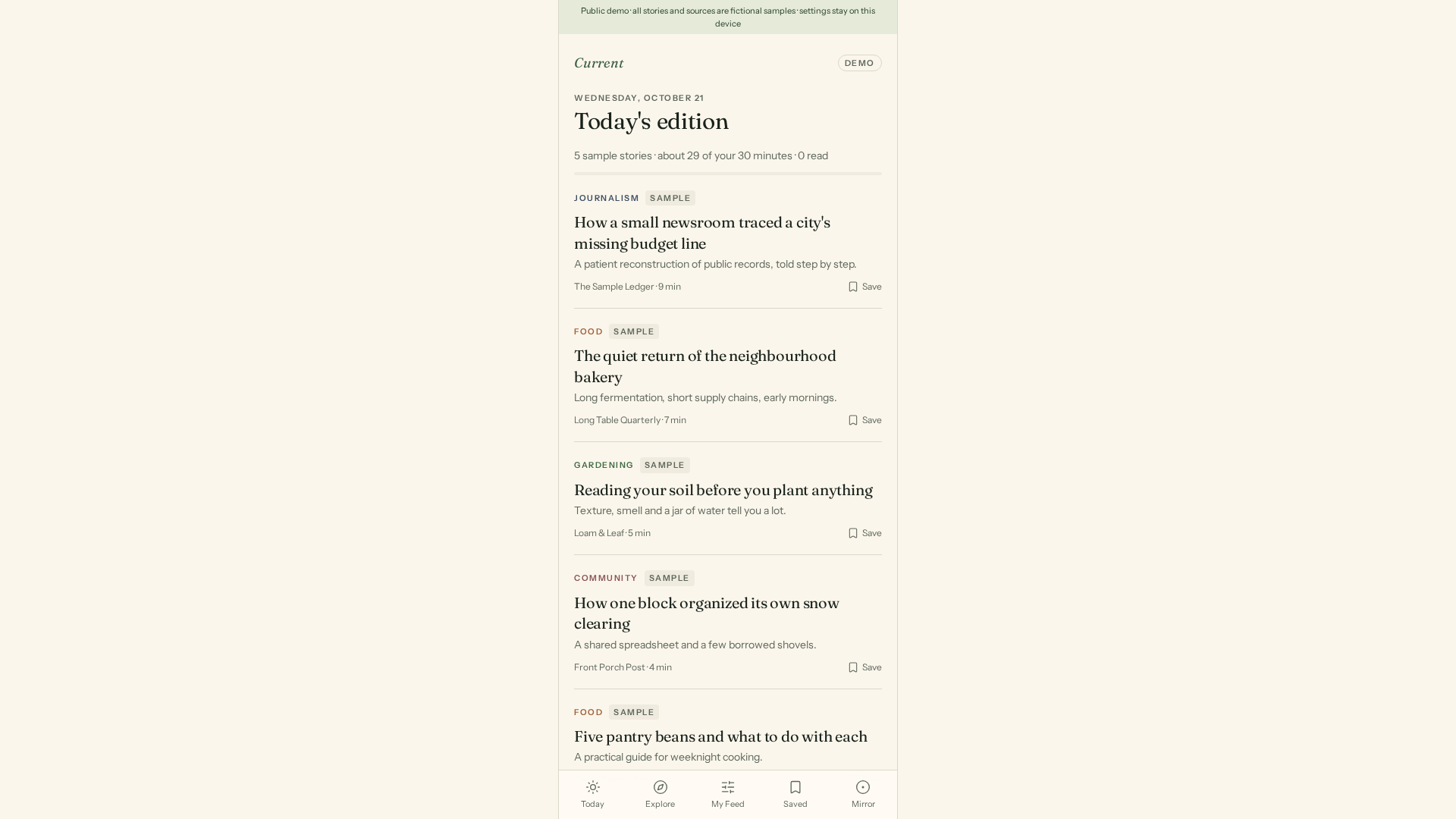
A personal information feed that follows your intentions, not an engagement algorithm.
I love discovering ideas, people, recipes, gardening inspiration, essays, local events and the occasional delightful video. But the feeds that deliver them tend to optimize for how long I'll stay, not whether the experience was worth my time. What if I could tell my feed what I cared about, choose the voices I trusted, and change the rules whenever I wanted? That's the idea behind Current: a feed on your terms.
There's already an early interactive prototype, but it uses sample content. It's a design exploration, not yet a live news feed or a functioning personalized recommendation engine. The next milestone is connecting verified live sources and making the ranking rules genuinely responsive.
Once it's ready, I'll run a small experiment: establish a baseline, use Current for seven days, share what worked and what didn't, then return at day 30 to see whether controlling my feed actually changed my relationship with information. A satisfying ten minutes may be more valuable than forty minutes of scrolling.
For now, Current is on the Concept Bar. Good ideas don't all need to become active projects at once.
Explore the prototype — limited-access preview; it may ask for sign-in. The screenshot above shows what it looks like.